Showing posts with label cinema. Show all posts

Saturday, May 14, 2011

well it sure does suck...

I hoped Suckerpunch was gonna be good. The trailer, to me, smacked of determined and passionate (albeit a bit simplistic and old-fashioned) feminism: a young girl is put into an insane asylum by her evil stepdad after her mum dies. To escape containment and lobotomy, the girl conjures up a battle field in her own imagination, and creatively “fights” her way out of through fantastical scenarios of war, guerrilla tactics and hand-to-hand fighting (at all three of which she kicks butt, as do the fellow female patients she includes in her escape place). The basic metaphor, I gathered, was something about the oppression of women by the evil and abusive institution of patriarchy that contains women through violence – but that women are able to “break free” through the creative power of their minds, and through banding together.

Of course, I saw problems with this metaphor – it positions all men as generically evil, and it suggests that a “freeing of the female mind” is enough to make women feel ok about the real violence and oppression they may have experienced (ie. you wouldn’t tell a rape victim to just fantasise about killing the rapist, and then assume her own trauma has been dealt with, or that “rape” as an issue in society has been removed). In any case: whatever misgivings I had about the trailer, I hoped they would dissipate through the course of film. THEY DIDN’T. (In fact, they grew and mutated in huge horrible monsters named Disbelief and Disgust).
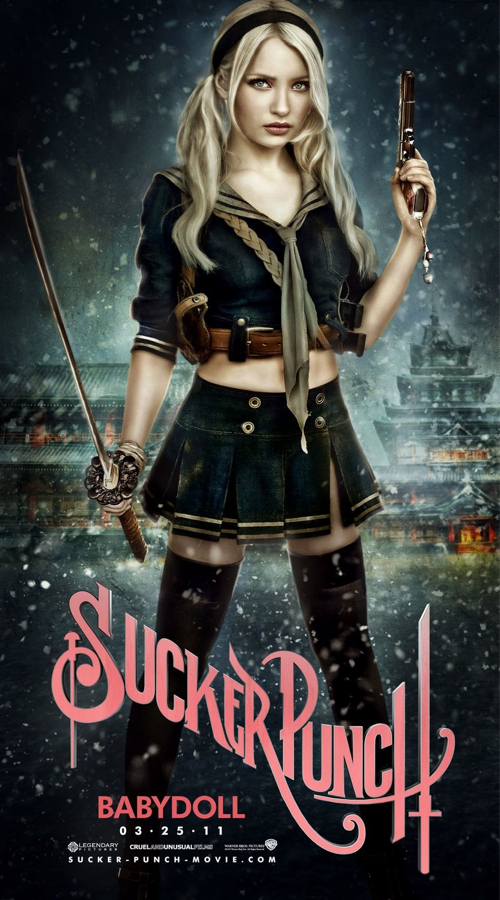
The offending school uniform get up.
For one, the whole film was a shameless excuse to get hot chicks flashing as much butt-cheek and cleavage as possible. Babydoll (the main character) actually has two levels of escapist fantasy – apart from world of fighting in her mind, she imagines that the mental hospital is crazy burlesque brothel (!!?!) where young (underage?) fake-tanned girls strut around in corsets, fishnet tights and stilettos, each with their own electronic rotating bed. The creepy lobotomy doctor becomes a creepy pimp and the “fantasy world” of fighting that I saw in the trailer can only be accessed by Babydoll when she does a pornographic stripper dance. It is while she mesmerises everyone with her “moaning” and “gyrating” (as the other girls in the film describe) that she can distract the chief doctor (pimp), the psychologist (the madam) and guards so that the other female patients can steal a map, a key and some other objects that will help during their escape. To the film’s credit, we never actually see the notorious dance. However, equating female, imaginative freedom with self-objectification and sexualisation is totally problematic, and suggests girls can only really achieve freedom through showing their bodies (which will only work if their bodies are “good enough” to have power over men). Obviously this is no freedom at all, and I should have realised at this stage that the film probably wasn't intended as a contribution to contemporary gender politics. 

In any case, the scenes which depict the gunfights and explosions in Babydoll’s fantasyland feature the girls in revealing school-girl uniforms, encouraging some weird paedophilic voyeurism on the part of the audience. Also, Babydoll meets some random old guy in the fantasyland who gives her instructions about what objects she needs to escape. On the “real” level of the story, one of the female patients does escape, thanks to Babydoll, and when she gets out of the hospital and into the town, the same random old guy is the bus driver, who gives her a knowing wink and lets her ride the bus for free. Babydoll and this woman, then, are actually totally dependent on this guy for having achieved any level of freedom at all. And yet we never find out who the heck this guy is – he’s just another vague male white father figure with the appropriate knowledge on how a women should behave (!!!?!). I’m not saying that men and women shouldn’t work together – of course I think they should. Some might argues that as a Christian (ie follower of Christ) that I am complicit in such a narrative of a masculine archetype - but actually, Jesus’ own history and claims are extremely specific and gender inclusive, as opposed to  the film's presentation of some vague cultural idea of manhood which refuses to account for its origin, its influence, or where it gets the omniscience it claims as natural to itself.

Plus, the film made no sense narratively. How did the real girls get into the brothel fantasy? The film nowhere explained what the correspondence was between the real life of the girl and her fantasies – presumably they matched up somehow, but it wasn’t clear. Plus, the fight scenes sucked – talk about boring, and pornographic. As my good friend blogged here[Snyder, the director] could have considered the fact that us chicks would definitely not be impressed by seeing the same jump and twirl that conveniently exposes lots of creamy thigh five times in a row (and countless of other times over the course of the movie.) And for the love of all that is holy, where is the gore?

I’m going to hold it there, even though I could write another thousand words on many other aspects of badness into the film. MORAL OF THE STORY: filmmakers need to get out of the habit of writing films that position men as automatically having negative power and women automatically being on the defensive. How else will we move forward out of this thinking, to an ideology where men and women can work together on equal terms? I know I sound ranty. Soon I will find something I like and write a happy post :) To cheer you up, here is a shot from the hilarious scene in Wayne's World that inspired the name of this post, and exemplifies my feelings towards Suckerpunch. Love yas! 

Thursday, February 3, 2011

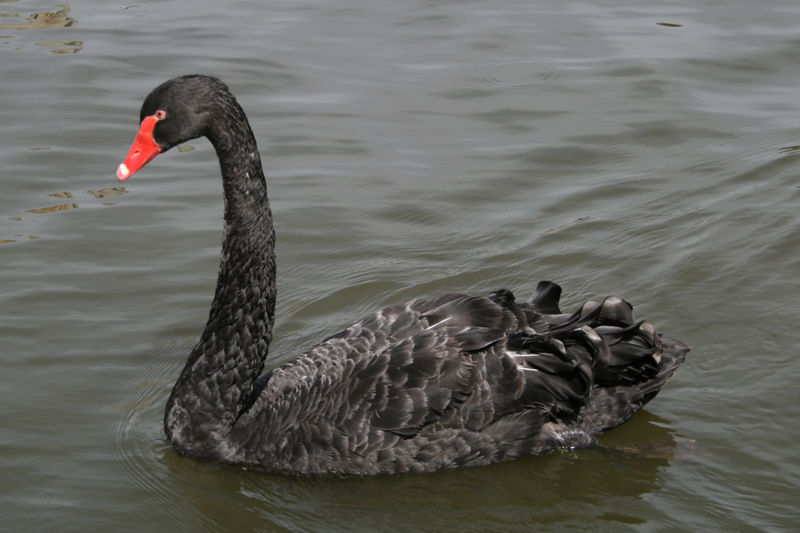
Fact: Black Swans are native to australia.

Naturally, this meant I had a total freak out after seeing Natalie Portman enact the psychotic episode that is her new film, Black Swan (dir. Darren Aronofsky). If you haven’t seen it, this post contains spoilers – not that that matters, because the story is based on Swan Lake, and even if it wasn’t, would be totally predictable anyway. Basically she’s a neurotic ballerina who has to play the Swan Queen in Swan Lake (both the black and white swan roles) and as the film progresses she becomes more and more entangled in a split personality disorder. She becomes violent and unpredictable, she can’t tell what is real or not and then ends up killing herself onstage in real life (just as the white swan kills herself after realizing her prince accidentally commits himself to the black swan).


Freak out! the black swan takes over. 
The tension of the film essentially lies in uncertainty around whether playing the split role caused her to become unwell, or whether her illess enabled her to perform the role so well. On the one hand, the film suggests she has a bunch of issues already (bulimia, a history of self-harm, crazy/repressed ballet mom who never got to “fulfil her career,” self-esteem issues, perfectionism, etc). On the other hand, the ballet industry seems to provide some impetus for triggering her mental illness: company director encourages the “dark side” of her to come out, by encouraging her to get sexual and trying to seduce her; rivalry with another dancer in the company spurs to fantasise about stabbing the girl to death (it is unclear for while though, whether Portman actually kills the girl or not), rivalry with the ex-prima ballerina who was booted so Portman could take the lead role (Portman then fantasises about this woman stabbing her face off with a nail file, though we don’t really know if it’s a fantasy or not). Etc. In the end, after receiving a standing ovation during the opening performance of Swan Lake, she jumps off the platform enacting the suicide of the ballet character, Odette – but simultaneously stabs herself in the gut and promptly dies. Curtain close. End film. Leave cinema feeling depressed and nauseated.

While Portman did give a stellar performance, and while Aronofsky did an effective job of getting the audience to feel as freaked out and confused as Portman’s character about what is real or not, there are some reasons why I REALLY DID NOT appreciate this film.

1. Gratuitously violent. The film is majourously gruesome with scenes of Portman imagining (or does she actually do it?) ripping her own fingernails out, peeling strips of skin from her arms and scratching the skin from her back. While this is not necessarily bad, it lent the film a horror-element which detracted from the psychological tension which was a lot more effective. The gory bits seemed thrown in to add some shock-factor, but were never really explored. At best they seemed a metaphor for the way that ballet/neuroticism was ripping her to shreds, (which in itself isn’t great as it reduces ballet to an awful metaphor, and fails to acknowledge the complexity around why people begin self-harming in the first place) and at worst, a cheap and nasty way of making a psychological thriller just that extra bit more nightmarish.

2. Based on a bunch of clichés. Portman’s “issues” that I mentioned earlier seem really extreme, and at the same time underdeveloped. Her eating disorder and relationship with her mother are not really investigated and the film seems to presume that the audience will fill this underdevelopment with stereotypes about the ballet industry. Plus – the misogynist ballet director, the sexy ballet-rival and the bitter-ex-prima-ballerina are worn out tropes that we have seen a gazillion times before. Plus, when Portman starts delving into her “dark side”, she does it to the max – goes out gets wasted, takes drugs, sleeps with some dude in the toilets, then has lesbian fantasy about rival-ballerina. I mean, what??!? It’s like they took every deviant act they could imagine and had her do it one night. (Plus, the positioning of her lesbian fantasy with the attractive rival as deviant seemed a) a failure to engage with gay relationships meaningfully and b) a cheap excuse to get attractive actresses naked).

How does such a pretty bird inspire such dread?
3. Glorifies suicide and offers no hope. While the film is clearly a tragedy, it offers NO HOPE. There is no empathy in the portrayal of Portman’s character, no pity for her plight: it basically says, if you’re crazy, there's no way out, you’ll wreck your own life and everyone else’s. Then she gets applauded as she kills herself – as if her real life death makes her great performance worth it. There is no questioning of how to deal with issues, and, due to all the clichés, no real accounting for why she might be the way she is. The film seems to blame ballet for all that goes wrong – but also seems to blame her own circumstances. Even the scenes of the actual dancing are limited, which means the audience don’t really get a sense of why Portman’s character would have invested so much of herself in it. Is it coz she wants fame? Money? Because she loves dancing? We don’t know.

Aronofsky is the master of gore and shock-factor, and though I never want to watch Requiem For a Dream again and wish I could erase most of it from my mind, at least that film demonstrated the consequences of a drug-lifestyle, how consumerism and capitalism destroy lives beyond repair, and the rampant sexism still occurring in a so-called post-feminist world. Black Swan, however, is problematic because it sets itself up to be a ballet film, but one that dishonours the ballet tradtion by filling it with a bunch of clichés; it sets itself up to be a psychological thriller, but  detracts from its tension with its schlock-horror-ness; it sets itself up to be a portrayal of mental illness, but portrays such illness unsympathetically with no real accounting for its cause or consequence. Apparently though, everyone else in the world loves it and it's raking in billions of box office dollars by the day. 

In any case, just to drag feminism into the mix, at least Portman has noted that it was unusual for a man to direct a film centering on female psychology, and that having more female Hollywood directors is something the industry we should aspire to. Read interview here.

Tuesday, January 4, 2011

how does peter pan grow up into uma thurman?

OK I’m writing this real quick coz I need to finish my PhD application TODAY however I just spent all morning trying to unlock a new racing cup on Mario Kart and now I feel dizzy from overdoing it on Rainbow Road. In any case hopefully writing a brief post will help bridge the intellectual gap between understanding Bakhtin’s idea of dialogism and avoiding being blown up by Bowser.

Jack hurts Peter by becoming Hook's "son"
I watched Hook for like the millionth time last night and of course it was amazing, who can get over Rufio’s midriff shirt and the cuteness of Maggie. But while the film has snappy dialogue, detailed sets, and hilarity (Robin Williams + Dustin Hoffman = deadly combo) it was full of BOYS. (Which of course makes sense, since Peter Pan is a boy, the Lost Boys are, well, boys, and Hook and Smee are men). The original female characters from Peter Pan (Wendy, Tigerlily) have been somewhat phased out/removed, in favour of Peter’s wife Moira and his daughter Maggie. But while Moira and Maggie play reasonably significant roles in the story, they are the morally stable and consistent ones: it is Moira who remains loyal to her family while Peter gets distracted by his working life, and Maggie who remains faithful to her family while Jack gets distracted by the attentions of Hook, who convinces Jack that Peter never really loved him.  Both father and son experience a crisis of ‘belonging’: once Peter realises that his “happy thought” truly is his son, he is able to fly and rescue his kids; once Jack understand he is his father’s happy thought, he apologises for betraying his father and allows himself to be saved. (At this stage, Maggie is of course already waiting to be saved and welcomes her renewed father back with open arms, just as Moira is waiting for her family to return from Neverland and welcomes her renewed husband with open arms). Marriage and family life become peaceful and whole again and father and son realise that the most important thing is loving and supporting each other.

The film is also about Captain Hook discerning his purpose (his purpose is to perpetually fight with Pan) as well as the lost boys, who are able to find a leader/father-figure in Pan again. I think the film does an effective and moving job of working through the issues associated with working through such crises, such as the need for humility and the importance of loving people in a way which puts them ahead of your own interests.

Watching Hook though, with its overwhelming amount of boys- hundreds of pirates, a large group of boy orphans, a man-hero with a conflicted son – made me ask the question: how many action/adventure films did I get to watch as a kid which featured girls? And I don’t mean just contained a token chick, but which actually portrayed the girl as the centre of the action. The films I loved as a kid were things like Hook, The Sandlot Kids, The Mighty Ducks, BMX Bandits, Aladdin, The Neverending Story, The Princess Bride, etc. Some of these contain strong female characters, such as the Connie and Tammy, the girl hockey players in the Mighty Ducks series. But other than that, not much. Others agree with me in the crisis of the female action hero - check out this Pajiba article for an argument that sounds a lot like mine, but provides an awesome and detailed list of the Best Female Action Heros! (lets just say that the fact the author puts Ripley from Alien and Sarah Connor from Terminator at the top of the list makes the author a LEGEND in my books).

I still wana be her when I grow up.
As a kid I didn’t really think about it that much, but as an adult (and potentially a parent one day) I would want my children, whether sons or daughters, to be exposed to films that portray male and female alike as able to participate in an action adventure. Not all little girls can faithfully sit there and await their parents to rescue them. Not all little girls should grow up to sit around at home waiting for their husband to “fix” everything (indeed: some little girls will not even get married, for a whole host of reasons). If girls can grow up to be as cool as Uma Thurman in Kill Bill, they should know it from a young age and not have to wait till they’re old enough to see an R-rated film! (Meaning kids films could include broader narrative/gendered possibilities – lets not show all 3-year olds Kill Bill).

To be honest I think that at the moment, cinema is doing a reasonable job of it. Hermione in Harry Potter is great, and in those books gender has no bearing on how or whether you participate in the fight of good against evil. You also get Lindsay Lohan in the Herbie films, Alice in Wonderland (this is an oldie but a goodie) and films like Hotel for Dogs and The Spiderwick Chronicles where again, gender is not a type of set role. Even though movies like Pirates of the Caribbean and How to Train Your Dragon contain cool female pirates/dragon-fighters respectively, these girls are one out of at least 10 men: I wonder if we will ever get to a point where an action film could contain all women and not be read as a type of feminist statement, but rather just enjoyed as another possibility. I hope we get there in my lifetime.

Friday, December 24, 2010

Pixie Lit xmas special!

Let’s face it: every Christmas you end up at a friend’s house drinking wine and sniffing pine needles and someone says ‘Hey! Lets watch a MOVIE!” and every year every December I do the rounds of offending nearly everyone I know by admitting that Love Actually is ACTUALLY my least favourite film. Ever. Since this has happened thrice this December already, I thought I would put together my personal list of the goods and bads that xmas film and tv have yielded over the years, and why they suck or rock.


BEST
Home Alone 1 & 2 - Everyone agrees. It’s got humour, it’s got bad guys, it’s got an ingenious kid that makes all kids watching think that they to could potentially foil two robbers in their tracks by beating them over the head with paint cans, etc. Plus – Harry’s scream when Kevin puts his brother’s tarantula on Harry’s face is potentially the best and funniest scream in the cinematic history.

A Muppet Christmas Carol - yes, I cry every time Tiny Tim speaks. Yes, the though of Kermit and Miss Piggy making babies is scary. But what could be better than Charles Dickens as a Muppet musical? It’s so cute and hilarious! Even the vegetables are scared of Scrooge!

Cute as pie!
To Grandmother’s House We Go - a lesser known and more controversial contender, this is the only Olsen Twins film I’ve ever seen. But I watched it every year as a kid, and I think it’s quite important because it means my Olsen twin memories are happy and fun and full of reindeers and fairy floss (as opposed to scandal, eating disorders, bad fashion sense, bad films, etc. Though Jared Padalecki starred in one of their later movies…awesome.)

Best. Kiss. Ever.
The Office Christmas Specials – portrays my favourite onscreen romance of ALL TIME (yes, I love it even more than Buffy and Angel, more than Simba and Nala, more than Leia and Han, more than me and a young Marlon Brando, which granted never happened ‘onscreen’): that of Dawn and Tim finally getting together. I cry every time I think of her opening her paint set in the car (in fact I’m welling up just thinking about it...)

A Mom For Christmas – Any tele-movie about a mannequin coming to life played by Olivia Newton John and being supermom and accidentally burning a house down deserves to be here no questions asked.

Santa Claus - And though I haven’t actually seen it, this looks incredible. A 1950s Mexican film about Santa fighting demons from space! Read summary here!

WORST
Dear Best Friend: you're booted if you try this.
Love Actually - apart from Alan Rickman who is great in anything (but best as Snape) and Colin Firth (also great in anything, but the GREATEST as Darcy) this films sends a terrible message! In fact Alan and Colin give terrible messages too even though I love them! What, love is anything you make it? Love is all around, in the affairs, and the sleeping around, and even though Colin Firth is amazing as if his part of the storyline would EVER happen! Talk about giving people unrealistic expectations! And Kiera Knightly’s husband’s best friend telling her he loves her AFTER she’s married? Inappropriate!  My best friend BETTER NOT PULL THE SAME STUNT or they won’t have a best friend anymore! GAHHH! And as if the little boy at the end would actually make through the airport in time to meet that girl! And as if a girl like that would ever kiss a guy like him! I’m sorry but it’s true! Laura Linney is the only person in the film who characterises love as being self-sacrificial when she gives up hooking up with the dude she likes in order to look after her brother, but even then the audience is left feeling like she got jibbed. Whatever happened to love being about the other person? About caring for someone in spite of yourself? For taking joy in serving another person? DIDN’T HAPPEN IN THIS FILM! PLUS EVERYONE IS SO FREAKING ANNOYING except Emma Thompson she’s quite good although she gets TOTALLY SCREWED OVER by her husband. LAME. Here endeth the rant.

Miracle on 34th Street - I could go on and on about this one as well but let me keep it brief: the conclusion of the film is basically that we should believe in Santa (and not just believe in him, but have it ruled in court that he exists) because “What’s worse? A lie that brings a smile? Or a truth that sheds a tear?” That’s right kids. It best to LIE to KEEP PEOPLE HAPPY. Don’t go near the TRUTH in case it UPSETS SOMEONE!!!

Home Alone 3 - Um…Macauley Culkin was in rehab (and was like 18 years old) at this stage, and since the largest fan demographic of the first two films were also like 18 years old (some too in rehab) at this stage I’m not quite sure who this sequel was trying to reach.

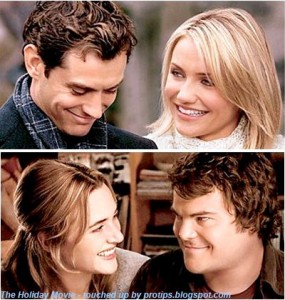
The so-called hierarchy of attractivness. A bad xmas msg!
The Holiday - Admitting I don’t love this film earns me more death stares than Love Actually. It’s not coz I don’t like the storyline (though of course it’s totally unrealistic. I have also already complained about Jude Law’s bad fake tan) it’s because what’s with ‘the hot’ couple and the ‘not’ couple? As if meeting the man of your dreams also equals meeting someone equally as attractive as you. Personally, I find Kate Winslet and Jack Black way more attractive than Jude and Cam-Cam, but please! It’s shameless!

Die Hard 2 – even though Die Hard is one of my favourite films and not strictly about Christmas, it does take place on Christmas Eve and is responsible for my fear of flying. Coz, what if some looney mucks up the instruments and my pilot misjudges the distance to landing and Bruce Willis isn’t there to light a cigarette and blow the looney up. 

Lets finish up with the greatest xmas special ever - Star Wars Happy Life Day. Keep an eye out for the baby wookie!


MERRY CHRISTMAS!

Thursday, November 25, 2010

re-filming cowboys

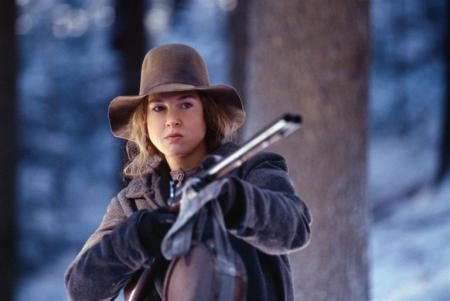
I nearly had a heart attack after opening my blog this morning and thinking I hadn't written about violence for like a whole post (but of course I had: the picture of Renee Zellweger holding a gun alerted me to this.) I think it was that I hadn't written about actual full-on crime violence, cowboys or Buffy for like a whole post.

BUT thankfully over the weekend I watched Once Upon A Time in the West, a 1968 film directed by the king of spaghetti westerns, Sergio Leone. Like most of his films, I spent the first hour trying to work out which cowboy was which (there were three main ones, each with their lackeys, and they all look kind of the same and sound the same and shoot people, and some of them were pretending to be other ones. So it's this whole confusing thing).

But it was such a joy to watch, for three main reasons:

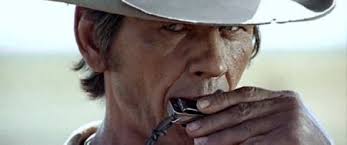
1. The cinematography. waahhh there just aren't words. It was beautiful: not just because of the amazing desert landscape, but also the facial-close ups (kind of making the face a landscape to written onto as well). For example:


The cowboys always fill the screen, even if, like the second screenshot above, the desert actually takes up more space. Sergio Leone is known as one of the first directors to make 'films-about-films' and Once Upon a Time in the West is a type of meta-western, simultaneously an homage to, and reworking of, the American western TV shows that were very popular in the early 60s. That every shot seems overwhelmed by men - and men who almost all die - perhaps signifies the impossibility of American TV cowboy ideology (the glorification of the frontier, expansion, violence, etc) actually surviving (or perhaps that Leone thought it should be 'killed off').

2. The story line. SO COMPLEX! I mean seriously, it was almost unnecessarily full of red herrings. But this was the great thing about it - it was not predictable at all and defied the Western fomulae that had, till this point, been assumed. For example, the three cowboys in the opening scene (shown in the bottom right screenshot above) are actually actors that have previously been cast as successfully violent cowboys in early American Westerns. They all get shot within the first five minutes and you realise: this film is about breaking down the stereotype. These men that who have committed violence in the name of America will be brought down. Ironically, it is another lone, American cowboy who shoots them. Here we see the cowboy at once vilified and exonerated (but I haven't thought about this enough to provide an interpretation yet).
          Leone provides a plethora of characters (the three cowboys - Harmonica, Frank and Cheyenne, a robber-baron, a young beautiful widow, and some other side characters) to mix and intermingle so many typical western storylines that it's hard to know what the film was actually about, or to articulate its plot. But I think this was intentional. Leone seems to have brought all these familiar storylines together in a way that is quite difficult to interpret, so that any reigning, America-focused narrative becomes not only impossible to read, but in fact absent.

Cardinale as Jill McBain
3. Claudia Cardinale (the actress who played the young gorgeous widow, Jill McBain). What a ROBOBABE! She is considered the first so-called "complex" female character in a Western: she arrives in town, a young wife, to find her husband and his children shot by Frank, who wants the McBain land. All three cowboys visit her a various times to try and find what was so valuable about the property (which, as it turns out, was the fact it had water on it and was right by the railway). She relates to these cowboys without fear, claiming to not even fear rape, because even if all the men had their way with her, she wouldn't be dead. Later, when Frank does try to rape her, she sleeps with him willingly so as not to be killed. She is then revealed to be a prostitute from New Orleans who fell in love with the land-owner McBain and decided to move to his ranch. The fact she is a prostitute explains her lack of fear about putting forth her body in order to survive, but complicates her role as lady-of-the-house. She is a whore who is respected by the cowboys simply because she is beautiful, and sexually beautiful. The fact she is prostitute means she is not the type of untouchable, Southern Belle that Nicole Kidman was in Cold Mountain, but an accessible woman whose beauty and body is available to men.
          Cheyenne, at the end of the film, says to her: "You know what? If I was you, I'd go down there and give those boys a drink. Can't imagine how happy it makes a man to see a woman like you. Just to look at her. And if one of them should pat your behind, just make believe it's nothing. They earned it." I mean, excuse me? I know, I know, it was '68 and '70 feminism hadn't quite made headways but STILL! "They earned it?" Who writes that? And the thing is, Jill does walk contentedly out into the midst of the workmen, bringing them water, like some sort of eternal female figure, a whore providing life-giving nourishment. Jill's character may have been complex but her objectification is portrayed as natural, and in fact, somehow good and life-giving. Gross. But, I guess women in Westerns had to start somewhere, right?

There are so many other great things about the film - the soundtrack, for one. Also it's clear Tarantino has watched this film about a gazillion times, the music, the cowboys, the stand-offs, the deliberate dialogue have pretty much just been inserted into the Kill Bills. But everyone should watch Once Upon a Time in the West. It will make everyone want to move to California and everyone want to marry a cowboy (even if you're a man. Trust me they're amazing).

Monday, November 22, 2010

Cold Mountain: not as cold as edinburgh.

Ok so normally I can’t stand Jude Law (ESPECIALLY in The Holiday, I mean WHAT is the with the fake tan? You live in England, and it’s SNOWING. And you’re cast as Kate Winslet’s BROTHER. In what way is a tan convincing?) But I did kind of warm to him in Cold Mountain, I think it was the fact he barely spoke a word, and played very convincingly the social awkwardness that comes with professing your love to someone before you know them properly, then being re-united with them years later after a war and wondering how to act and treat them. Which, basically, is the story of Ada (Nicole Kidman) and Inman (Jude Law) in Cold Mountain.

Renee as Ruby
What I liked even more than Jude Law was the relationship between Ada and the girl who comes to help her manage her farm once her father’s died and Inman has gone to war. The girl is Ruby, played by Renee Zellweger, a young girl abandoned by her father who knows everything there is to know about growing crops, building fences, baking pies, and finding her way around the nearby mountains. When Ruby first arrives, she finds Ada dying of starvation due to her inability to do anything (including grow food), inability to make money (she’s a ‘lady,’ she doesn't work!) and her pride, which means she is too ashamed to continue relying on other’s charity. As Ada cries when Ruby first arrives,

I can talk about farming in Latin. I can read French. I can lace up a corset, God knows. I can name the principal rivers in Europe, just don't ask me to name one stream in this county! I can embroider but I can't darn! I can arrange cut flowers but I can't grow them!

But within a few short months, Ruby has transformed Ada from profoundly useless Southern Belle to hardy, herb-growing, fence-building, pie-baking, not-starving lady-now-mountain-girl. Ada can repay her neighbours’ charity by cooking them food. She can protect her and Ruby’s friends, (deserters from the army) with a shotgun that she has learnt to shoot. In losing her role as lady, Ada gains the ability to survive as a woman dependent only on herself and other women.

What is most interesting about this transformation is that Ada arrives in Cold Mountain as the  traditional, beautiful Southern Belle – but one physically trapped by this position, not just by her corset, but by her lack of skills which force her into poverty once she is away from the money and society of men. It is only in shunning her role as lady that Ada is able to regain pride in herself, can participate in social transaction without shame (by baking food for her neighbours as payment) and gains a friend. This does come at some cost, though – for while her father’s death, a symbolic death of the patriarch, creates the space for Ruby to enter the father’s house and transform his daughter, Ada still experiences grief at this loss. She must also sell her beloved piano – the one thing of her old life that she loves and is good at – to have enough money to survive one particularly cold winter.

The doomed couple.
The other main cost is her loss of Inman. She does remain dependent on his memory and the possibility he will return, to get through difficult times. Initially, I felt uncomfortable about this because I felt it undermined the feminine independence she develops with Ruby. However, when Inman does finally return, years down the track, it’s actually not too clichéd. They don’t run to each other and make out. She nearly shoots him, then realizes who it is, and then they have an awkward conversation about how strange it is too see each other. (Then of course they get over it, hook up overnight in a mountain shack, and then he gets shot the following day protecting them from the City Guard. And of course she got pregnant from the one night they spent together and it’s the whole romantically tragic thing. But anyway).

While this ending was a bit predictable and attempted to pull every heartstring the audience had (admittedly, I cried LOTS) it does point to something quite profound: Inman’s return without death was actually an impossibility. This type of transformed, independent woman cannot exist with the providing husband on her arm. Ruby, on the other hand, who grew up with survival skills and who effectively taught herself  independence, can get married (and does). Ada’s narrative seems suggest that there is something about the act of shedding an old feminine role, or the act of removing a stereotype cast upon you, which inevitably involves loss, and probably some sort of masculine loss. It is this loss which catalyses Ada's transformation. Hence, Inman needs to die for Ada to remain who she has become, while Ruby can marry and have children because she has not has to “shed” anything: she is a type of independent woman who can choose a man without needing to revert to dependence on him.

Or something like that, anyway. Maybe I’ve been WAAAAY too sucked in by Hollywood, but as you know, I always am! Because it’s FREAKING COLD in Edinburgh right, and much nicer to stay inside watching and fantasizing about Hollywood that go outside in the rain. (But I still love Edinburgh. Don’t get me wrong).

Wednesday, September 8, 2010

Flying with De Niro: How "Heat" got me thinking


I obviously had only one choice on the 25-hour flight towards Edinburgh: stay awake and watch as many action movies as possible. Unfortunately, I only got through five before I passed out from tiredness and overeating (Qatar Airways definitely don’t skimp on the food). I started out with Heat (dir. Michael Mann, 1995) not realising I’d already seen it – but the rewatching got me thinking about the gender dynamics of action cinema and in particular, heist-films.

Pacino as Lt. Hanna
Heat is a story about two men, how they work, what they might prioritise, and the personal cost associated with these prioritisations. McCauley (Robert De Niro) is a high-profile thief and heist-master; Lt. Hanna (Al Pacino) is a jaded yet relentless cop obsessed with catching McCauley. The film is basically an exploration of what happens when you live by McCauley’s motto, Do not have any attachments, do not have anything in your life you are not willing to walk out on in 30 seconds flat if you spot the heat around the corner.” Both McCauley and Hanna are willing to walk out on relationships to  respectively avoid getting arrested/catch the bad guy. By "relationships", I mean both friendships with other men (and potentially each other) and also with women. McCauley walks out on a life of companionship with the sweet Eadie, who stays with him even after discovering he is a criminal, and Hanna walks out on his wife Justine and his stepdaughter, Lauren, who he has a soft sport for.

Even though Heat is not predictable and keeps you on the edge of your seat, the plot is not that surprising once it pans out. Experience tells us that thieves in heist-films usually end up with the girl and/or the prize (think The Italian Job, Inside Man, National Treasure, Gone in 60 Seconds, Ocean’s 11) as they are usually told from the thieves’ perspective, and we like seeing them stick it to the man. The alternative is we see it from the cop’s perspective and want to see justice done, so the thieves end up dead and the cop gets the girl (think Point Break, and all James Bond films). Heat’s originality lies in the fact we end up sympathetic to both cop and thief, wanting both to succeed, but also thinking the two of them are somewhat selfish, blinkered men who can’t see what’s important in life. Because McCauley and Hanna essentially lead the same life despite being on different sides of the law, it’s no wonder they both die: McCauley literally, as he is shot, and Hanna figuratively, as he has given up his family and just shot the one man who understood him and who, in a way, respected him.

Heat is a clever exploration of the heist protagonist and antagonist, deals effectively with moral ambiguity, and demonstrates the personal cost of McCauley and Hanna’s choices in a relatively moving way. However: what the heck happened to the women?

Justine, Eadie, Lauren: three women whose actions and presence are the main catalysts for the dilemmas Hanna and McCauley find themselves in, and yet they are written out of the story without so much as a backward glance. The final cut of Lauren is her bloodied body after she tries to commit suicide; the final shot of Justine is her trying not to cry as Hanna has just left their marriage for good; the final shot of Eadie is her bewildered face as McCauley walks out on her without explanation. The film ends with the chase between Hanna and McCauley and you get the impression that the women’s lives are merely the collateral damage of a boys’ club which deals with the “real” issues of life, such as thievery and justice.

But how do these women go about piecing their lives back together? How have they been affected by the actions of the men in their lives? Eadie, already suffering from chronic loneliness, surely lost all faith in all relationships after seeing McCauley walk away from her. Lauren just tried to kill herself and will wake up to find that her stepfather, the one person who vaguely cared for her, is gone. These are significant issues but there is no set of films that deal with what is going on.

Ashley Judd as self-sacrificial Charlene
I don’t mean to criticize Heat or suggest it should’ve been different. It’s important to explore the complexities of masculine cinematic roles and Heat does this well, and it certainly doesn’t endorse McCauley and Hanna’s treatment of women (more reveals it as a grim reality). Besides, Eadie, Justine and Lauren are in no way portrayed as weak or subservient – they are strong, bold and not afraid to stand up for themselves. In fact the character I admired most was Charlene (the wife of Chris, McCauley’s crime partner) who was the only person to actually take a risk and make a sacrifice for the person whom she loved (arguably she put her kid at risk in the choices she made, but the principal remains that she was the only character in the entire film to not put herself first). My point, though, in raising the Justines, Eadies and Laurens of the heist genre is that there is no archetypal narrative trajectory for these women: we simply don’t know what happens to them.

In defence of action cinema (one of my true loves) the genre has actually done a lot for women. The role of the gun-fighting, fist-fighting female is now common (though sometimes over-sexualized – but that is a another discussion altogether). This woman may be a reasonably 2D character (like Scarlett Johansson’s character in Iron Man 2) or a complex one (think Uma in the Kill Bills, Sigourney Weaver in Aliens, and to take it back to my faves, Princess Leia and Buffy). These may not be heist films per se, but you get the drift. 2D or 3D, these representations have been seminal in the development of female characterisation in cinema. What we rarely see, though, is what happens to the wives, the girlfriends, those who have been dropped when the heat’s around the corner. Romantic-drama The Time Traveller’s Wife deals with this to an extent (and actually the family-action flick Hancock through Charlize Theron’s character does quite a job of it). But I wish there more! Justine and Charlene were so interesting and drove the whole storyline – it’s such a travesty that these bold women have been ignored, when we know (mostly) what happens to any male character – even the periphery ones – in any heist film (they get the money, get the girl, or die and lose the girl).
To be honest I think feminists have had so much to say about cinema for so long because the archetypal trajectory for females in heist films is one where women get written out of stories – it is by nature problematic. However: never a fan of “victim” feminism, I will end by saying that the Justines, Eadies and Laurens of cinema have an important place in films like Heat, though films like Heat shouldn't dictate the representation of women in action films. Also, maybe I should give myself a kick up the bum and write some stories about these female characters myself, instead of complaining that no-one else has!

NB. Regarding Hancock, was anyone else mildly nauseated by (and yet strangely appreciative of) Charlize Theron’s eyeliner and low-cutted-ness once she became all hardcore and powery? Part of the feminist in me wishes they’d kept her all pretty and house-wife-like – the other part just thinks that all chicks should wear that outfit, all the time.

Thursday, August 12, 2010

Ellen Page films etc

So I’ve been sick all week and thankfully my cousin from Scotland is here to help me overeat brownies and complete the ‘Colossus’ crossword in the Women’s Weekly without a thesaurus. The other thing we did was hire out Juno and Whip It and watch them in succession (with a 20 minute break in-between to bake cornflake cookies). As it turns out, Ellen Page is quite the talented actress. Having recently seen Inception too, I’m kind of into this tiny pale-skinned girl who manages to still look good with messy hair, oversized jeans and flannel shirt – her costume in all three films, pretty much.

EP in Whip It
In some ways, Juno and Whip It are the same film. Girl-in-small-town surprises parents-who-love-her with bombshell (pregnancy/roller derby respectively) and family makes their way through aftermath with fights, tears, swearing and hugs. Girl goes through difficult life lessons. Has fight with boyfriend/best friend. Girl gets wise words from parent/older friend, eats humble pie, apologises and VOILA: girl has baby successfully/takes part in roller derby successfully, and everyone’s a winner even though the proposed adoptive dad of the baby turns out to be sleaze bag, and the derby team comes in second in the championship. Substitute Juno’s cute acoustic soundtrack with Whip It’s cute girl-punk soundtrack and there ain’t a whole lot of difference in terms of overarching story arc. In fact there is nothing particularly new about this story arc at all: girls come-of-age through similar plot lines in a) Clueless, b) Mean Girls, c) Buffy the Vampire Slayer, d) Labyrinth, e) Degrassi High and f) the Saddle Club (books and ABC series).
And yet: Juno and Whip It still seem original. Neither of them stray far from the template (and everyone loves a template, otherwise we wouldn’t cry every time we see Frodo realises what a jerk he’s been to Sam) but the catalysts they use for exploring the template – teen pregnancy, and roller derby – are reasonably unique and till now unaddressed in the teen flick genre.

Whip It is a little more templatey than the June-dog – it contains a bunch of speedy and unexplainable plot turns (Bliss just happens to be in Austin and see a derby team in a store and just happens to sneak off to Austin to watch them and just happens to be a great skater even though she hasn’t skated for years and just happens to get immediately accepted into the team). But these things are forgivable because the film isn’t primarily about roller derby – it’s about Bliss realising how much her mum loves her, how much she loves her mum, the importance of doing what you love but the importance of communicating and respecting those who have sacrificed a lot for your happiness. This heart of the story is expressed so effectively (I cried both times) that the film can be excused for not wholly focussing on the feminist undertones of roller derby and the real ins and outs of the sport.

EP as pregnant gal.
Juno skims over some details too (6 months of pregnancy go by a little too quickly – and where the heck does Michael Sera get to? He totally appears conveniently when Juno is ready to crack it with life and then again when she’s ready to apologise) but where Whip It sacrifices some storyline for the sake of the template, Juno keeps the template and manages to engage a little more comprehensively with the issue at hand. Teen pregnancy is rarely addressed so positively in films – in Juno, abortion is barely an option, the parents are hugely supportive, and the 16 year old is the one who makes all the decisions – by herself – about the future of her baby. And through this Juno learns her coming-of-age life lessons about trusting people, the importance of being valued for who you are, and the importance of seeing other people for who they really are.

Aww! So warm and fuzzy, the both of them. I won’t get started on Inception but let me just say Ellz does an awesome job at breaking down the male protagonist’s ego – literally! Freud is probs turning in his grave. But it's all about helping Leo become the man he wants to be. So she gets a go at helping others learn life lessons…all part of the great circle of life.